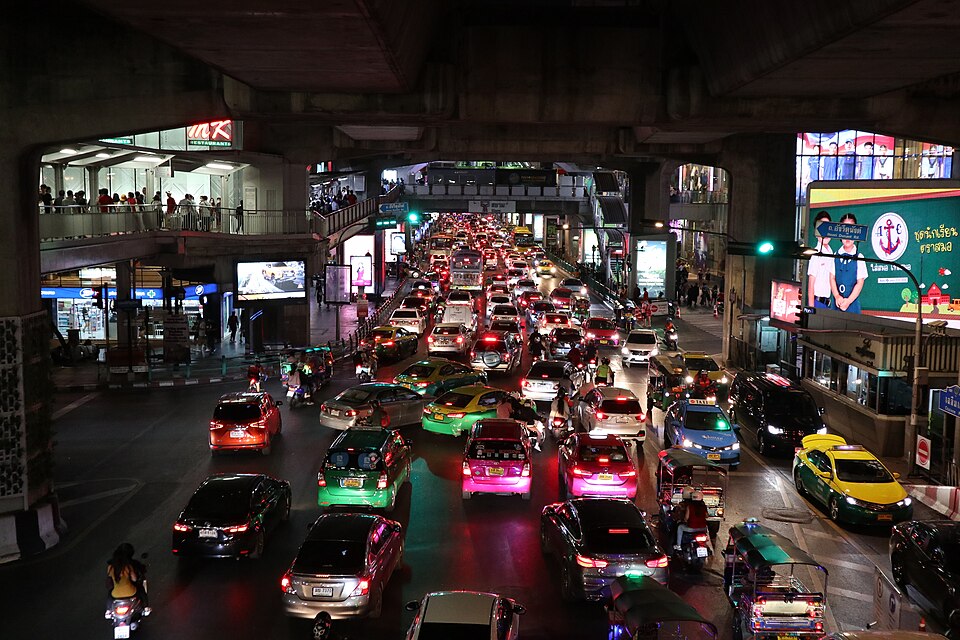
Traffic jam at rush hour [1]
Under capitalism, we produce everything for the individual. Even basic necessities are commodified and sold, leading to massive waste.
How many washing machines sit in people’s homes, unused most of the time? How many rarely-used kitchen appliances? How many workshop tools that are needed once every few months?
These things don’t simply fall out of the sky; it is still us who have to work in order to produce this excess. We are willingly allocating a large part of our limited resources to the production of objects that are not in use most of the time.
Cars are possibly the most wasteful form of transportation. Relying on cars for general transportation means that we need to produce a big, heavy, and complex machine for every single person or family, which they are not going to be using much of the time. Even when in use, they are generally driving alongside other people who have their own personal engines, wheels, tires, etc.
Cars are poison when it comes to cities. They force the construction of wide roads, which are taken up in large part by drivers. They also require parking lots, which take up a lot of space, and move destinations farther away from each other. This makes other forms of transportation, such as walking and cycling, often infeasible in a car-centric urban area.
A “library of things” is a library which can contain any object of any kind. Items can be stored there, and borrowed by people who only occasionally need to make use of them.